SME Merger and Acquisition (M&A) Advisory Fee Models: Why a "Success Fee Only" Arrangement Is Risky for Both Sides
3 min read
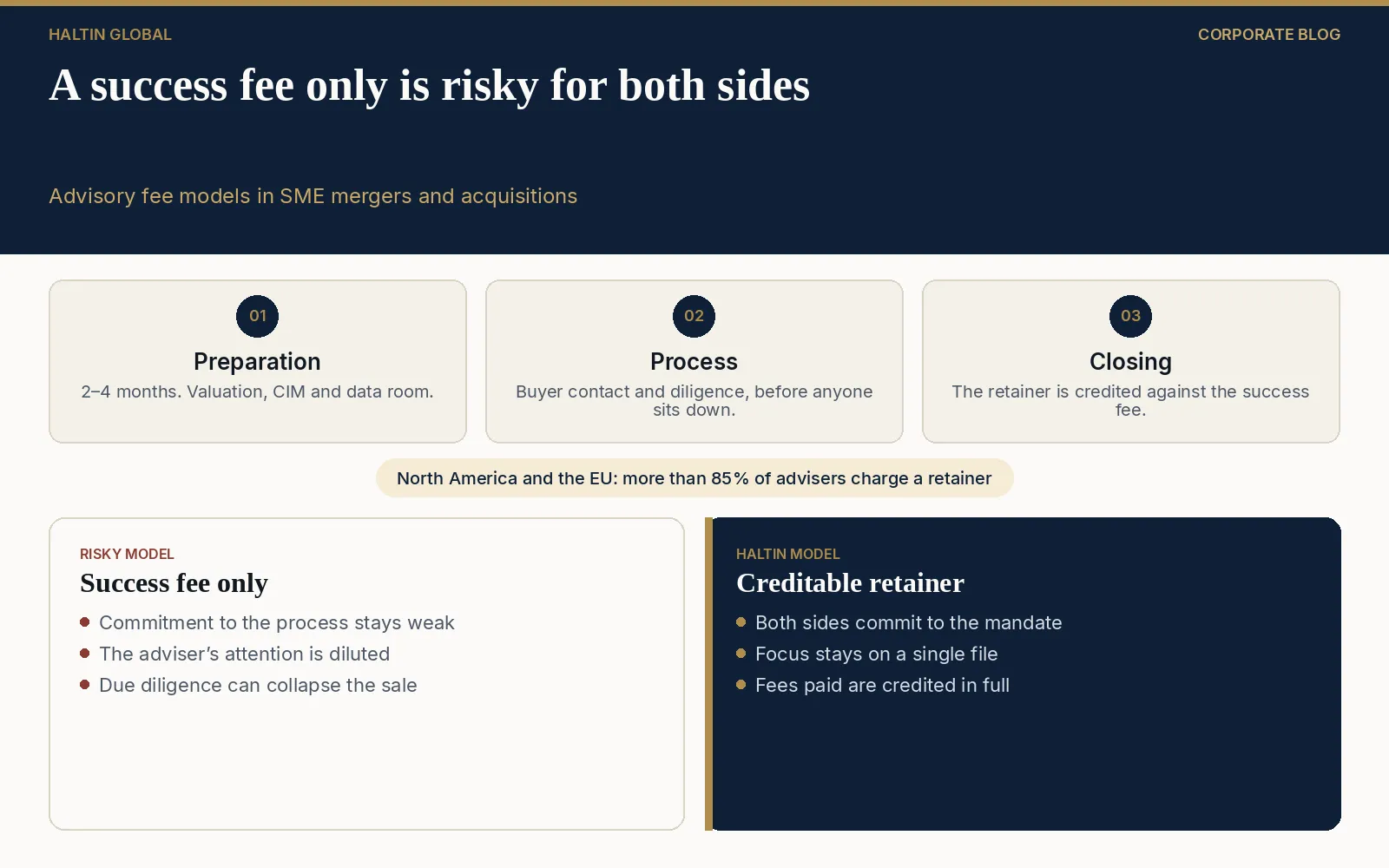
A success-fee-only mandate looks cost-free to an SME owner, but it weakens commitment on both sides. Haltin Global credits the retainer in full against the success fee when the sale closes.
Hakan Altınkeser · HALTIN GLOBAL
Selling a company, forming a partnership or disposing of a block of shares is among the most consequential strategic decisions an owner will make. In sell-side M&A for SMEs, the advisory fee structure is one of the choices that shapes the financial architecture of the whole process.
Owners of SMEs in Turkey often put the same proposal to M&A advisers: “Complete the process, sell the company, and take your fee from the final purchase price.”
At first glance this model — a success fee only, or contingency fee — looks cost-free and risk-free for the owner. In practice it creates serious disadvantages for both owners and professional advisory firms.
M&A Is Not a Property Sale: The Heavy Preparation Phase
Selling a factory, a production plant or an established business follows entirely different dynamics from transferring a standard commercial property. Before the opportunity is ever put in front of buyers, these stages have to be completed with care:
- Financial normalisation. An SME’s operating profit (EBITDA) is adjusted for one-off expenses and personal balance-sheet items and brought into line with international investor standards.
- Valuation. A defensible valuation base is built from real market multiples, discounted cash flows (DCF) and sector comparables.
- Marketing documents (teaser and CIM). A blind teaser that protects confidentiality is prepared together with a detailed confidential information memorandum (CIM).
- Data room (VDR) and diligence preparation. Legal, tax and operational risks are identified and addressed before the buyer begins due diligence.
This preparation phase requires two to four months of uninterrupted specialist work, analytical effort and institutional cost — even before anyone sits down with a buyer.
How Is It Done in the World and in Turkey?
In North America and the European Union, more than 85% of M&A advisers charge a fixed work fee (a retainer or engagement fee) throughout the process. By global standards this fee is accepted as what underwrites the seriousness of the mandate, and it is credited against the final success fee when the transaction closes.
In Turkey, a reflex to avoid upfront cost means “success fee only” models are common. On most files opened this way, the following outcomes become hard to avoid:
- Commitment to the table (skin in the game). Management teams that have made no financial commitment can leave the process on subjective grounds after months of preparation and buyer contact — “let’s wait for now”, or “the price I wanted did not come”. Months of work are then wasted.
- Diluted advisory focus. Firms that do not charge a retainer have to take on a large number of companies simply to survive. The company then does not receive the dedicated strategic focus and analytical care it needs. The file sits on the shelf under a “it will sell if we are lucky” logic.
- The due diligence barrier. When tax, employment, shareholder current-account or contract risks at an unstructured SME are not cleared professionally in advance, the buyer leaves the table. In processes with no preparation budget, these risks are what overturn the deal.
The Balanced Model: A Creditable Retainer
At Haltin Global, the approach we follow is to run the process as a shared objective and a mutual commitment.
The most balanced and transparent formula is to agree a reasonable monthly advisory fee (a retainer) that covers the operational load of the process, and — when the company is successfully sold — to deduct every amount collected, in full, from the success fee that has been earned.
The owner then recovers the advisory fees paid, at closing. The adviser can devote its full energy, its international buyer network and its analytical capacity to that file, and maximise the company’s real value.
- M&A
- SME
- advisory fees